It's early April in southern Saskatchewan. The snow's mostly gone, but the fields are still too wet to get on. You're standing in the yard, looking at the truck that got you through another winter — the one with 280,000 km on it, the one that groaned pulling the grain trailer last October, the one that needed a boost at minus-38 in January. You're asking yourself the question every farmer around Moose Jaw asks eventually: is this the year I need a different truck?
It's not a small decision. A work truck on a Saskatchewan farm isn't a commuter vehicle. It's a tow rig, a parts-run vehicle, a mobile office during seeding, and the only thing between you and a very long walk when you break down on a grid road 40 km from the nearest town. Get the wrong truck and you'll feel it every day of that two-week harvest window when time is money and breakdowns aren't an option.
This guide is for the farmer standing in that yard right now. We'll break down exactly what the 2026 Silverado and Sierra lineup can do, what they can't do, and which one actually fits how you farm. No sales pitch — just the straight goods from people who've seen what these trucks go through on the Prairies.
The Half-Ton Question — When Is a Silverado 1500 Enough?
Let's be honest up front: a half-ton truck is not a replacement for a proper heavy-duty rig on a working grain farm. But a half-ton is the right truck for a lot of Saskatchewan operations — especially if you're running a smaller acreage, a mixed operation where the truck mostly does errands and light hauling, or you need a daily driver that can pitch in during the busy season.
The 2026 Silverado 1500, properly configured with the Max Trailering Package, tops out at 13,300 lbs of towing capacity. That's with the 6.2L V8 or the 3.0L Duramax turbo-diesel inline-six. Maximum payload is 2,260 lbs on the Work Truck trim.
Here's what that means in practical terms:
- Great for: Running to Peavey Mart or Richardson Pioneer for parts and supplies, pulling a stock trailer with a handful of cattle, towing a flatbed with fence posts or hay bales, daily driving between the yard and town.
- Adequate for: Pulling a small to mid-size equipment trailer, towing a loaded bumper-pull grain trailer on short field-to-yard moves (check your weights carefully).
- Not enough for: Regularly pulling a loaded tandem grain trailer on the highway, moving heavy implements like a 40-foot cultivator, hauling anhydrous tanks, or any situation where you're consistently near or above 12,000 lbs.
For cold-weather reliability, the 2.7L TurboMax and the 5.3L V8 are both proven Saskatchewan winter starters. The 3.0L Duramax diesel is excellent for fuel economy but remember — diesel requires more cold-weather care at minus-30 and below.
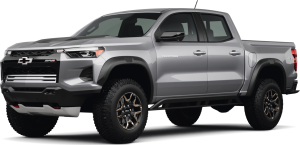
The Silverado 1500 LT Trail Boss with the 5.3L V8 gives you a 2-inch factory lift, Z71 off-road suspension, skid plates, and Rancho shocks. It handles grid roads well and has enough ground clearance for spring mud. It's not a heavy hauler, but it's a solid farm errand truck that won't punish you on a 90 km run into Moose Jaw.
If your operation is under 500 acres and you're not regularly towing heavy loads, a properly configured 1500 will serve you well. Once you're north of that, keep eading.
When You Need the Heavy Iron — Silverado 2500HD and 3500HD
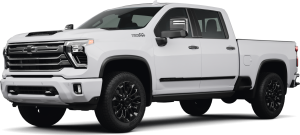
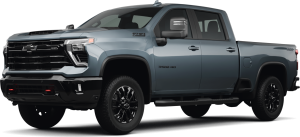
This is where the real farm truck conversation starts. The 2026 Silverado HD lineup is built on a fully boxed high-strength steel frame with the Allison 10-speed automatic, and it comes in two flavours: the 6.6L V8 gas engine (401 hp, 464 lb-ft of torque) or the Duramax 6.6L turbo-diesel V8 (470 hp, 975 lb-ft of torque). Both are serious. The diesel is another level.
2026 Silverado Towing & Payload Comparison
| Spec | Silverado 1500 | Silverado 2500HD | Silverado 3500HD (DRW) |
|---|---|---|---|
| Max Conventional Towing | 13,300 lbs | 20,000 lbs | 20,000 lbs |
| Max 5th Wheel / Gooseneck | 10,300 lbs | 22,500 lbs | 36,000 lbs |
| Max Payload | 2,260 lbs | ~4,039 lbs | ~7,442 lbs |
| Engine Options | 2.7L Turbo, 5.3L V8, 6.2L V8, 3.0L Diesel I6 | 6.6L V8 Gas, 6.6L Duramax Diesel | 6.6L V8 Gas, 6.6L Duramax Diesel |
| Best For | Light farm use, daily driver | Most prairie farm operations | Heavy gooseneck, commercial hauling |
Silverado 2500HD
This is the truck that fits the majority of Saskatchewan grain and mixed-farm operations. With the Duramax diesel, you get up to 20,000 lbs of conventional towing and 22,500 lbs of fifth-wheel/gooseneck towing. That covers grain trailers, header trailers, most livestock trailers loaded, and a wide range of implements.
The 2500HD gas engine is genuinely underrated for farm use. At 401 hp with 464 lb-ft of torque, it handles most towing tasks. The upfront cost is significantly lower than diesel — roughly $10,000 less — and if you're not putting on huge highway kilometres or towing heavy loads daily, the gas 2500HD is a smart, honest choice. You won't see a fuel economy payback on diesel if you're under 30,000 km per year.
Silverado 3500HD
When you need gooseneck towing capacity that doesn't flinch, the 3500HD dual-rear-wheel with the Duramax is the answer. Up to 36,000 lbs of fifth-wheel/gooseneck towing and roughly 7,442 lbs of payload. This is the truck for moving a 40-foot cultivator between quarter sections, pulling a fully loaded tri-axle grain trailer, transporting a swather on a dedicated trailer, or hauling anhydrous tanks.
The DRW (dually) configuration is essential for stability at these weights. The wider rear stance distributes load across four tires instead of two, which matters on soft grid roads in spring and loose gravel in summer. If you're running gooseneck applications regularly, don't try to do it with a single-rear-wheel — the 3500HD DRW exists for a reason.
Real-World Scenarios
- Moving a 40-ft cultivator between fields: 3500HD DRW diesel. No question.
- Hauling a grain cart to the field at harvest: 2500HD diesel handles this well. 3500HD if it's a large cart.
- Pulling a 25-ft header trailer: 2500HD diesel is more than adequate.
- Daily driver that doubles as harvest truck: 2500HD gas. Lower cost, proven reliability, and enough capability for seasonal heavy use.
- Towing livestock to the auction mart in Swift Current: 2500HD diesel for a loaded cattle trailer. Torque at low RPM makes loaded pulls on Highway 1 feel controlled.
The Duramax Diesel Advantage
The 6.6L Duramax paired with the Allison 10-speed is the powertrain that makes sense for high-mileage Saskatchewan farm use. At 975 lb-ft of torque, it pulls loaded trailers without strain. Fuel economy under load is meaningfully better than the gas V8 over long distances — and on the Prairies, every trip is a long distance. Moose Jaw to Saskatoon for an implement dealer is over 250 km one way. You feel the difference over a full season.
GMC Sierra — Same Muscle, Different Feel
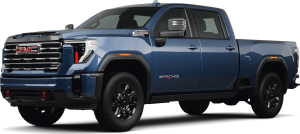
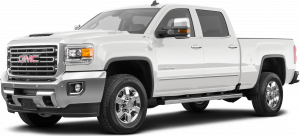
Everything we just said about the Silverado HD applies equally to the GMC Sierra HD. The Sierra 2500HD and 3500HD share the same platform, the same frame, the same engines, and the same Allison transmission. The capability numbers are essentially identical. The difference is how they're dressed.
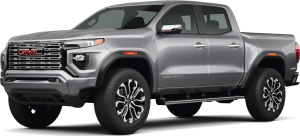
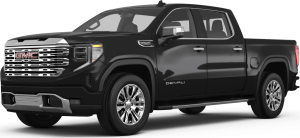
The Sierra AT4 brings a more aggressive appearance with an off-road suspension package, while the Sierra Denali and Denali Ultimate offer a premium interior that's a genuine step up — leather,real wood trim, 16-way power seats with massage on the Ultimate. Some farmers want a truck that works hard Monday through Friday and doesn't feel like a work truck when they drive to the lake on Saturday. The Sierra Denali HD does that.
The MultiPro tailgate on the Sierra is worth mentioning specifically for farm use. It's a six-function tailgate that converts into a load stop, a full-width step, and a raised work surface. During harvest, when you're working out of the truck bed constantly — sorting tools, checking paperwork, staging parts — that built-in work surface at a comfortable standing height is genuinely useful. It's not a gimmick.
The honest note: the choice between Sierra and Silverado usually comes down to personal preference, interior preference, and what's available on the lot or through custom order. You are not giving up or gaining any towing or payload capability by choosing one over the other. Drive both. See which cab feels right. The truck underneath is the same.
Saskatchewan-Specific Considerations Nobody Talks About
This is the section the manufacturer's brochure doesn't cover. If you've farmed near Moose Jaw — or anywhere in the Palliser Triangle — you already know some of this. But it's worth putting it all in one place.
Grid Road Performance
Southern Saskatchewan grid roads are their own category of driving surface. They range from well-maintained gravel to rutted, soft, muddy nightmares during spring thaw and after summer rains. All HD trucks have adequate ground clearance (the Silverado 2500HD sits at about 10.4 inches), but what matters more is your differential and 4WD setup.
A locking rear differential is critical on muddy grid roads in April and during wet harvest conditions. It's standard on most HD trims. Use it. Also, if your truck offers both auto 4WD and manual 4WD selection, use the manual setting on off-camber grid road situations. Auto 4WD can react unpredictably when one side of the road is soft and the other is firm. Manual selection — 4HI or 4LO — gives you consistent, predictable power delivery.
Cold Weather: Diesel Gelling and Battery Life
Saskatchewan cold is not theoretical. Minus-40 happens. At those temperatures, diesel fuel gels — the paraffin wax in the fuel solidifies and clogs filters and fuel lines. This isn't a manufacturing defect; it's chemistry.
Diesel owners must:
- Use a quality fuel additive (like Howes Diesel Treat or Power Service) from October through April.
- Always plug in. The block heater isn't optional. At minus-30 and below, an unplugged diesel may not start, and forcing it risks injector and glow plug damage.
- Consider a battery blanket or dual-battery setup. A cold diesel engine demands enormous cranking amps, and a weak battery at minus-40 is a dead truck.
The gas 6.6L V8, for what it's worth, is more forgiving in extreme cold. It doesn't glow-plug cycle, it doesn't gel, and it starts reliably with a functioning block heater and a good battery. This is one of the honest trade-offs between gas and diesel in Saskatchewan.
Grain Dust and Cab Filtration
During harvest, you're driving through grain dust constantly — at the combine, at the bin yard, on grid roads behind other equipment. The Silverado HD's cabin air filter is doing real work during those weeks. Change it more often than the manual suggests. A plugged cabin filter during harvest means dust inside the cab, which means dust in your HVAC system, which means a musty truck all winter. Carry a spare filter in the glove box during harvest. It's a $25 part that saves you grief.
Long Distances and Fuel Range
One of the realities of farming in the Moose Jaw area is distance. Regina is 70 km east. Saskatoon is 260 km north.Swift Current is 170 km west. When you need a part, an implement dealer, or a veterinarian, you're driving. Fuel range matters.
The Silverado HD has a 36-gallon (136-litre) fuel tank. With the Duramax diesel on the highway(not towing), you can expect roughly 900–1,000 km of range. Towing heavy, that drops to 500–650 km depending on load and wind. Still enough to make a round trip to Saskatoon without fuelling up. The gas V8 will use more fuel under load, so plan your fuel stops accordingly on longer hauls.
Southern Saskatchewan Terrain and Tires
The Palliser Triangle is relatively flat, but flat doesn't mean easy. Spring thaw creates soft spots that can swallow tires. Field approaches and grid road shoulders are unpredictable. Summer dust turns to slick mud after a rain.
For a farm work truck, all-terrain (AT) tires are the right choice — not highway all-seasons. A good AT tire gives you grip on gravel, mud, and snow while still being reasonable on the highway. Pure mud tires are overkill and noisy on the 100+ km highway drives you'll do regularly. AT tires are the Goldilocks choice for Saskatchewan.
SGI Farm Plates
If your truck is used primarily for agricultural purposes, you may be eligible for farm-class (Class F) licence plates through SGI. Farm plates offer lower registration fees and insurance premiums compared to standard passenger or commercial registration. The eligibility requirements tie to the same definition of "farmer" used by the province's fuel tax rebate program. It's worth asking about when you register your new truck — the savings add up over the life of the vehicle. Your local SGI issuer or Murray GM's F&I team can walk you through the specifics.
How to Choose at Murray GM Moose Jaw
When you come in — or call — here are the questions that actually matter:
- What's the heaviest thing you'll tow regularly? Not once a year, but regularly. This determines whether you're in 1500, 2500HD, or 3500HD territory.
- How many kilometres per year? If you're north of 30,000 km/year and towing often, diesel starts to make financial sense. Under that, gas is likely the better value.
- Do you need gooseneck or fifth-wheel capability? If yes, you're looking at 2500HD minimum, and likely 3500HD DRW for heavy gooseneck applications.
- Gas or diesel? Be honest about your usage. Diesel is roughly $10,000 more upfront. It pays back in fuel savings only if you're driving high kilometres under load.
Don't settle for whatever's on the lot if it doesn't match your needs. A custom-ordered work truck, spec'd exactly for your operation — right engine, right bed length, right axle ratio, right hitch prep — is worth the 8–12 week wait. A truck that's almost right is one that frustrates you for the next 10 years.
Spring is the time to assess. Before seeding starts and the busy season makes it impossible to think about anything but the crop, take an honest look at what you're driving. If the truck is costing you time, money, or peace of mind, that's the answer.
Ready to Find Your Work Truck?
Come see us at 15 Chester Road in Moose Jaw. No pressure — just a conversation with people who understand what a Saskatchewan farm truck actually needs to do.
Murray GM Moose Jaw · 15 Chester Road, Moose Jaw, SK · murraygm.com
The Bottom Line
Choosing a work truck isn't about horsepower numbers or towing ratings on a spec sheet. It's about matching the truck to the work. A Silverado 1500 is an excellent truck — for the right operation. A 2500HD with the gas V8 is the quiet workhorse a lot of farmers overlook. A 3500HD DRW Duramax is a serious investment that makes serious sense if you're pulling serious weight.
Think about what you're towing, how far you're driving, and how cold it gets where you park. If you can answer those three questions honestly, the right truck becomes obvious. And if it doesn't, that's what we're here for.
Saskatchewan farming is hard enough. Your truck shouldn't make it harder.
Murray GM Moose Jaw — murraygm.com — 306-693-4605
15 Chester Road, Moose Jaw, SK